Quick answer: Erg Chebbi is a sand sea of wind-built dunes in south-east Morocco, about 22 km long from north to south and a few kilometres wide, with its highest dunes reaching around 150 metres. It sits right beside the villages of Merzouga and Hassilabied and is best explored by camel, on foot at sunrise, or with a night in a desert camp.
For us, Erg Chebbi is not just scenery; it is home. We watch its colours change every day, from pale apricot in the morning to deep copper at sunset. Yet for all its fame, Erg Chebbi is surprisingly compact and easy to reach, which is exactly what makes it the most popular place in Morocco to experience the Sahara.
What exactly is Erg Chebbi?
An erg is a large area of wind-blown sand dunes, a "sand sea". Erg Chebbi is one of two major ergs in Morocco, the other being Erg Chigaga near M'Hamid. It rises abruptly from the flat, dark, stony plain called hamada, which makes the orange dunes look even more dramatic when you approach from Rissani.
The sand here has a distinctive reddish-orange colour thanks to iron oxide coating the grains. Prevailing winds keep reshaping the ridges, so the dunes you climb this year are subtly different from last year's, though the big star-shaped dunes remain in roughly the same places.
Size and the highest dunes
Erg Chebbi stretches roughly 22 km from north to south and between about 5 and 7 km at its widest. The tallest dunes rise around 150 metres above the surrounding plain; the highest ones lie in the central part of the erg, east of Merzouga village. Climbing one takes between 30 and 60 minutes depending on fitness, and it is steeper than it looks, because each step slides back a little. The reward is a 360-degree view across the sand sea toward the Algerian border in the east.
Villages around the dunes
- Merzouga: the main village at the western edge, with shops, auberges and the starting points for most camel treks.
- Hassilabied: a quieter village about 5 km north, with many family-run auberges and camps close to the dunes.
- Khamlia: about 7 km south of Merzouga, home to a community of Gnawa musicians descended from sub-Saharan peoples.
- Taouz: further south, known for ancient rock engravings and old mining areas.
- Rissani and Erfoud: the market towns of the Tafilalet oasis, about 40 km and 55 km north respectively.
North-west of the erg lies Dayet Srji, a seasonal lake that fills after rare heavy rains and can attract flamingos in spring.
How to experience Erg Chebbi
Camel trek and desert camp
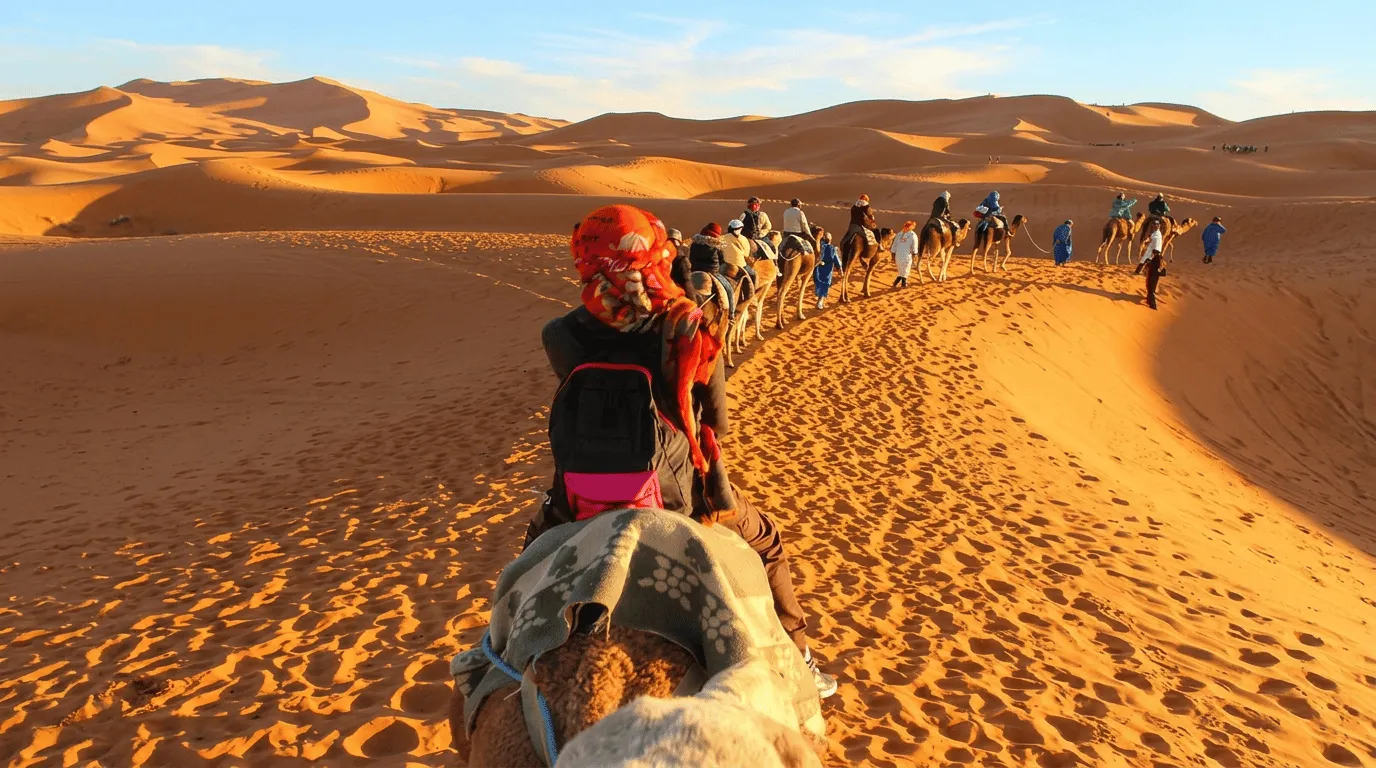
The classic way. You ride a dromedary for about an hour to 90 minutes into the dunes, watch the sunset from a ridge, then spend the night at a camp with dinner, drums and an extraordinary night sky. At dawn you climb a dune to watch the sunrise.
On foot
Walking in the dunes early in the morning is magical and free. Stay oriented by keeping the village or a high dune in sight, carry water, and avoid the heat of the middle of the day.
By 4x4, quad or sandboard
A 4x4 tour circles the erg and visits nomad families, Khamlia, fossil sites and old mines. Quad bikes and buggies are available in designated zones, and the steep dune faces are perfect for sandboarding.
Best time to visit the dunes
Spring and autumn offer the most comfortable temperatures, while winter gives sunny days and cold nights and summer requires planning around the heat. Within any day, the best light is in the first hour after sunrise and the last hour before sunset, when the ridges cast long shadows. Our seasonal guide to Merzouga goes into detail.
Life around the erg
Erg Chebbi is not an empty wilderness. Nomad families, many of them from the Ait Khebbash tribe, still graze goats and camels on the plains around the dunes and live in low tents of woven fabric. Around the villages, small gardens are watered by traditional channels, and palm groves supply dates. Fossil-rich rock in the wider Tafilalet region has also created a whole local industry in Erfoud and Rissani, where ammonites and trilobites are polished and sold. A half-day 4x4 loop around the erg is the easiest way to see this human side of the desert, including the Gnawa music of Khamlia and the old lead mines near Mifis.
Wildlife is discreet but present: desert foxes (fennecs), jerboas, lizards and beetles leave tracks you can read in the sand at dawn, and birdwatchers come for desert species such as the desert sparrow and the Egyptian nightjar.
Respecting the dunes
Erg Chebbi is a living landscape shared by camel herders, nomad families and local communities. A few simple habits help protect it:
- Take all rubbish back with you, including cigarette ends and plastic bottles.
- Ask before photographing people, especially nomad families.
- Keep motorised vehicles out of camp areas and away from villages; responsible operators use designated routes.
- Do not take sand, fossils or stones from protected areas in large quantities.
- Keep noise down late at night; sound travels far in the silence of the desert.
How to get to Erg Chebbi
Merzouga is roughly 470 km from Fes and 560 km from Marrakech, with the nearest airport at Errachidia, about 130 km away. See our full guide on reaching Merzouga by road, bus or plane. For a direct comparison with Morocco's other desert area, read our Merzouga vs Zagora comparison.
Discover Erg Chebbi with local hosts
The quickest way to reach the dunes from the north is our 2-day Fes to Erg Chebbi desert tour, from €190 per person, with a sunset camel ride and a night at our camp. You can also browse all our Sahara tours or contact us to build your own days in the dunes.