Quick answer: The best time to visit Merzouga is from March to May and from late September to November, when days are warm (roughly 22-30°C) and nights at camp are comfortable. Winter (December-February) is sunny but cold after dark, while June to August brings 40°C+ afternoons that only suit early mornings and late evenings on the dunes.
We live and work at the edge of Erg Chebbi, so the question we hear most often is simply: when should we come? The honest answer is that the Sahara is beautiful all year, but it is not equally comfortable all year. Merzouga sits at around 700 metres above sea level on the edge of the Tafilalet region, and the desert climate here swings hard between day and night and between summer and winter. Choosing the right month changes how much you enjoy the camel ride, the night at camp and the long drive in.
Merzouga weather at a glance
Below is a simple overview based on what we experience on the ground each year. Temperatures are typical ranges, not guarantees; the desert always keeps a little surprise in reserve.
| Season | Daytime | Night at camp | Our verdict |
|---|---|---|---|
| Spring (Mar-May) | 22-32°C | 10-18°C | Excellent, occasional windy days |
| Summer (Jun-Aug) | 38-46°C | 25-30°C | Hot; plan around early and late hours |
| Autumn (Sep-Nov) | 24-34°C | 10-20°C | Excellent, calm and clear |
| Winter (Dec-Feb) | 16-21°C | 0-5°C | Crisp, sunny, cold nights |
Spring (March to May): our favourite season
Spring is when the Sahara feels most generous. Days are warm enough for T-shirts, the light over the dunes is soft and golden, and evenings around the campfire are pleasant rather than freezing. After a wet winter, the seasonal lake at Dayet Srji north of Merzouga can hold water, sometimes attracting flamingos and other migrating birds.
The one thing to know about spring is wind. March and April are the months most likely to bring a sandstorm, locally called a chergui when it blows hot from the east. Most blow over in a few hours. We keep an eye on the forecast and adjust camel departure times when needed, and a good scarf (a cheche) solves most of the discomfort.
Spring also overlaps with Easter holidays in Europe, so this is a busy period. If you are travelling in April, book a few weeks ahead, especially for private tours.
Autumn (September to November): calm, clear and golden
Autumn rivals spring and many of our team would actually choose it. September can still be hot in the afternoons (often above 35°C in the first half of the month), but by October the heat softens and the air is usually still and very clear. That clarity makes for exceptional stargazing and sharp sunrise views from the top of the big dunes.
October is also date harvest season across the Tafilalet oasis and the Ziz Valley. Driving in through Erfoud and Rissani, you will see palm groves full of activity, and the date festival in Erfoud usually takes place in the autumn.
Winter (December to February): sunshine and cold nights
Many travellers are surprised by how cold the desert gets. Winter days in Merzouga are often bright, sunny and around 18-20°C, perfect for walking the dunes or exploring Khamlia and Rissani. But once the sun drops, the temperature falls fast, and nights at camp can reach freezing point in late December and January.
That does not make winter a bad choice. Christmas and New Year in the desert are special, the dunes are quieter outside the holiday weeks, and our camps provide heavy blankets. You simply need to pack properly: a warm jacket, a hat, thermal layers and warm socks for the night. On the route from Marrakech, the Tizi n'Tichka pass (2,260 m) in the High Atlas can occasionally see snow, which sometimes delays departures by a few hours.
Summer (June to August): possible, with the right plan
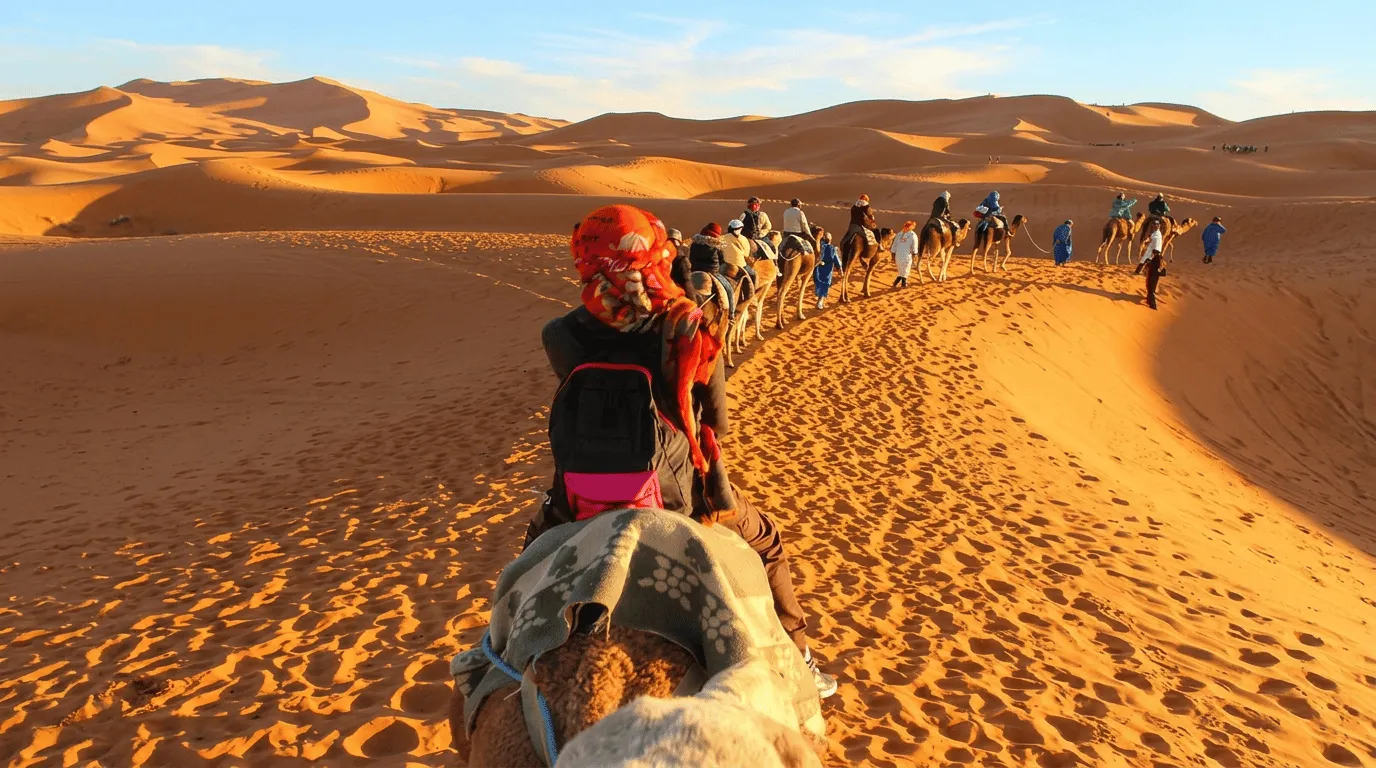
July and August are the hottest months, with afternoon temperatures commonly above 40°C. We still welcome guests in summer, and plenty of families come during school holidays. The key is timing: camel treks leave in the late afternoon, sunrise is early, and the middle of the day is for resting in the shade, swimming at an auberge pool or visiting shaded kasbahs.
If you travel in summer, drink more water than you think you need, avoid dark heavy clothing and consider spending the hottest hours on the drive in an air-conditioned vehicle rather than outdoors. Some local families also practise sand bathing in the dunes in summer, a traditional remedy you may see around Merzouga.
Other things to consider when choosing dates
Ramadan
During the holy month of Ramadan, tours run normally and restaurants for travellers stay open, but daily life in villages slows during the day and becomes lively after sunset. It is a lovely time to experience local hospitality, and we simply ask guests to be discreet about eating and drinking in public places.
Crowds and prices
Peak periods in Merzouga are Easter, late October to early November, and the Christmas to New Year week. Prices for our tours stay stable, but camps and private vehicles book up fast. The quietest months are January (after New Year), February and the height of summer.
Moon phase
If stargazing matters to you, check the lunar calendar. Around the new moon the Milky Way is spectacular over Erg Chebbi; around the full moon, the dunes glow silver and you can walk them without a torch. Both are memorable, just different.
How long to stay once you choose your month
Merzouga is roughly 560 km from Marrakech and about 470 km from Fes, so the journey itself is part of the experience. Whatever the season, we recommend at least one night in the dunes and ideally two nights in the area, so you can enjoy both sunset and sunrise without rushing. If you are starting from Marrakech, our 3-day Marrakech to Merzouga desert tour splits the drive over two days via Ait Benhaddou and the Dades Valley, which works well in every season.
For a detailed look at the drive itself, read our Marrakech to Merzouga route guide. And once your dates are set, our Sahara packing list will help you prepare for the temperatures of your chosen month.
Our month-by-month summary
- January-February: quiet, sunny, very cold nights. Great for photographers who do not mind layers.
- March-April: warm and lively, occasional wind. Book early for Easter.
- May: hot afternoons begin, still lovely evenings.
- June-August: intense heat; go early, go late, rest at midday.
- September: heat fading, clear skies.
- October-November: arguably perfect, with the date harvest in Tafilalet.
- December: festive and cold at night, pack warmly.
Plan your Merzouga trip with us
Tell us your travel dates and we will tell you honestly what the desert will feel like that week, what to pack and which route makes the most sense. Our Marrakech to Merzouga desert trip starts from €240 per person, and every itinerary can be adapted. Send us a message and our local team will help you pick the right moment for your Sahara adventure.