Quick answer: The Marrakech to Merzouga route covers about 560 km and 9-10 hours of pure driving, crossing the High Atlas via the Tizi n'Tichka pass, then Ouarzazate, the Dades Valley, Tinghir (Todra Gorge), Erfoud and Rissani. We recommend splitting it over two days with an overnight in the Dades Valley.
People sometimes see the drive from Marrakech to the Sahara as something to get through. We see it the other way around: it is one of the most beautiful road journeys in North Africa, and it tells the story of southern Morocco, from the snowy Atlas to the red kasbahs and palm oases, and finally the orange sand of Erg Chebbi. This is the route our drivers know by heart.
The route at a glance
| Stage | Distance | Approx. drive time |
|---|---|---|
| Marrakech - Tizi n'Tichka - Ait Benhaddou | ~190 km | 3.5-4 h |
| Ait Benhaddou - Ouarzazate | ~30 km | 30 min |
| Ouarzazate - Skoura - Boumalne Dades | ~115 km | 2 h |
| Boumalne Dades - Tinghir (Todra) | ~55 km | 1 h |
| Tinghir - Tinejdad - Erfoud - Rissani - Merzouga | ~190 km | 3 h |
Times are for driving only. Photo stops, lunch and visits easily add three to four hours, which is why we never recommend doing it all in one go.
Stage 1: Crossing the High Atlas
Leaving Marrakech early, the road climbs through Berber villages and walnut groves toward the Tizi n'Tichka pass, at 2,260 metres the highest major road pass in Morocco. The N9 is well surfaced but full of bends, and heavy trucks slow things down. In winter there can be snow at the top; the road is cleared quickly, but occasionally it closes for a few hours.
On the descent, the landscape changes dramatically: green gives way to ochre and red, and the first earthen villages appear. Many trips detour via the Ounila Valley and Telouet, an older caravan route with a crumbling Glaoui kasbah.
Stage 2: Ait Benhaddou and Ouarzazate
Ait Benhaddou is a fortified ksar on a hill above the Ounila river, and a UNESCO World Heritage Site. Its earthen walls and towers have appeared in many films and series. Plan about an hour to walk up to the granary at the top for the view. We cover it in detail in our separate visitor guide.
Ouarzazate, half an hour further, is known as the gateway to the desert and for its film studios and the Taourirt Kasbah. It is a good place for lunch and a fuel stop before the long valleys ahead.
Stage 3: Skoura and the Valley of Roses
East of Ouarzazate, the road passes the palm oasis of Skoura, dotted with kasbahs such as Amridil, then Kelaat M'Gouna, the heart of the Valley of Roses. In late April or early May, the Damask rose harvest fills the valley with scent and the town celebrates with a rose festival. At other times you can still buy rose water and cosmetics in local cooperatives.
Stage 4: The Dades Valley, our overnight stop
At Boumalne Dades, the valley opens north into the Dades Gorges. A short drive up this side road leads to the famous hairpin bends at Tizi n'Tadrht and to rock formations locally known as "monkey fingers". Guesthouses along the river make this the ideal place to spend the first night: you arrive before dark, and the next morning you have fresh energy for the second half of the route.
Stage 5: Todra Gorge and on to the desert
Near Tinghir, the Todra Gorge narrows to a canyon with rock walls up to about 300 metres high, with a clear stream running through. It is a pleasant half-hour walk and a favourite with climbers. From Tinghir, the road runs east through Tinejdad and past lines of khettara, old underground irrigation channels you can see as rows of craters in the plain, then south via Jorf to Erfoud.
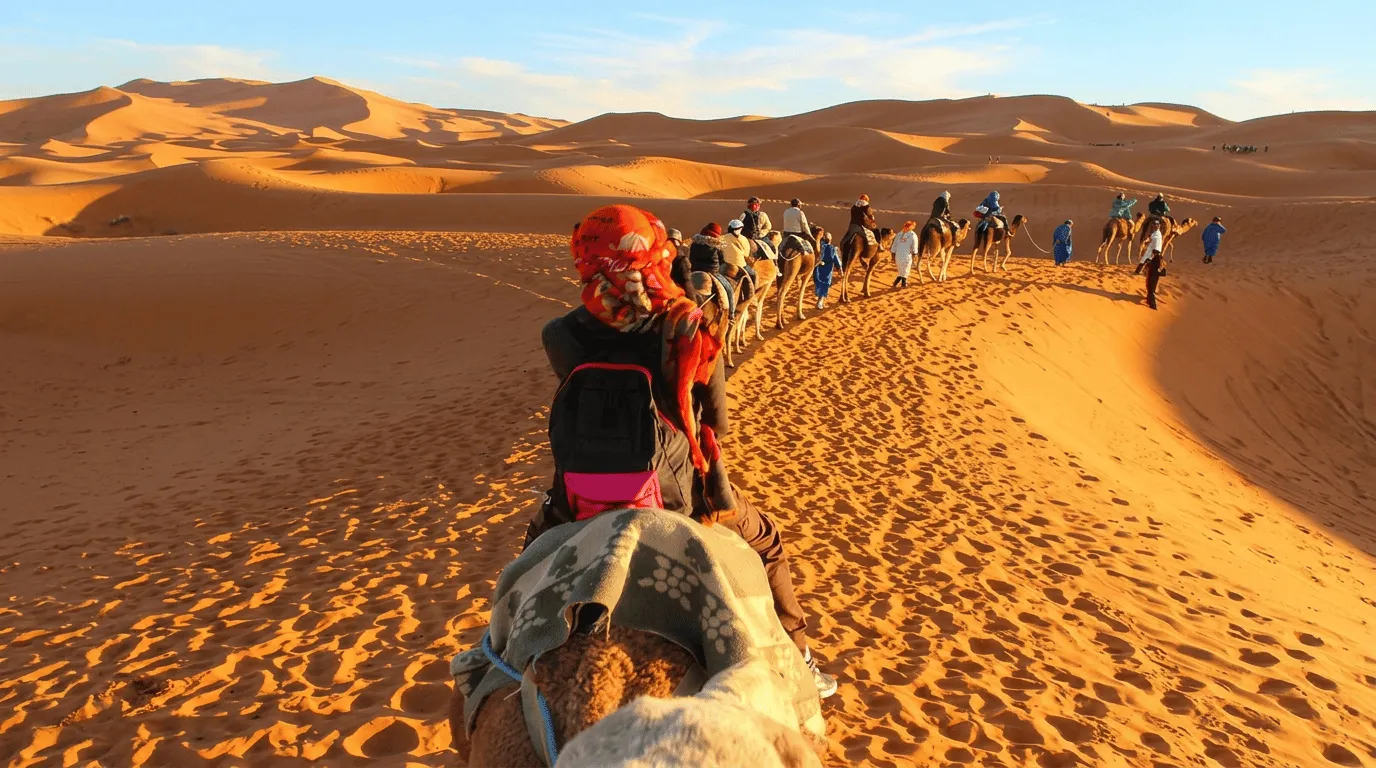
Erfoud is known for its fossil workshops, where marble full of ammonites and orthoceras is cut and polished. A little further, Rissani is the historic centre of the Tafilalet oasis and home to a lively traditional market. From there, the last 40 km bring you to Merzouga, and suddenly the dunes of Erg Chebbi rise on the horizon.
One day or two?
The straight drive is 9-10 hours without any real stops. Add Ait Benhaddou, lunch and a few photos and it becomes a 12-hour day, leaving you exhausted when you should be enjoying the sunset camel ride. That is why our 3-day Merzouga desert tour from Marrakech spends the first night in the Dades Valley, arrives in Merzouga on day two for sunset, and returns to Marrakech on day three.
If you have an extra day, it is even better to continue north to Fes instead of driving back the same way; the route via the Ziz Valley and Midelt is completely different scenery.
Practical tips for the road
- Start early. Leaving Marrakech around 7:30 or 8:00 gives you the Atlas in morning light and less traffic.
- Motion sickness: the Tichka bends are the only really winding section; take a tablet before you start if you are sensitive.
- Cash: ATMs exist in Ouarzazate, Boumalne, Tinghir, Erfoud and Rissani, but small villages often only take cash.
- Layers: it can be 10°C colder at the pass than in Marrakech.
- Drive by day: if you self-drive, plan to finish each stage before dark.
Related reading
Before you finalise dates, check our guide to the ideal season for a Merzouga trip. And if you are still weighing up a short trip against a longer one, our honest look at whether a 3-day desert tour from Marrakech is worth it may help. For other ways of arriving, see how to get to Merzouga.
Drive the route with our local team
We would love to show you this road the way we see it, with the stops that matter and time to breathe. The Marrakech to Merzouga tour starts from €240 per person including transport, a night in the Dades Valley and a night in our desert camp. Contact us to plan your dates or adapt the itinerary.