Quick answer: Ait Benhaddou is a UNESCO-listed fortified village (ksar) of earthen houses about 190 km southeast of Marrakech, roughly 3.5 to 4 hours by road over the Tizi n'Tichka pass and 30 km from Ouarzazate. Walking into the ksar is free, a visit takes 1 to 2 hours, and it is the classic first stop on any Marrakech to Merzouga desert tour.
Almost every traveller who drives from Marrakech towards the Sahara stops at Ait Benhaddou, and for good reason. The village climbs a small hill above the Ounila riverbed, its reddish towers and walls made of rammed earth and mud brick, with a fortified granary crowning the top. We pass through it several times a week with our guests, and it still makes us slow down. This guide shares what we tell people in the van: how to get there, when to go, what you are actually looking at, and how to fit it into a longer trip to the dunes.
What is Ait Benhaddou?
A ksar (plural ksour) is a fortified communal village, typical of the pre-Saharan valleys of southern Morocco. Ait Benhaddou grew along the old caravan route that linked the Sahara with Marrakech across the High Atlas. Families lived inside the walls in clustered houses, some with defensive towers (these tall family houses are what people call kasbahs), and grain was stored in the collective agadir at the top of the hill.
The site was inscribed on the UNESCO World Heritage List in 1987 as an outstanding example of southern Moroccan earthen architecture. Today only a handful of families still live inside the old ksar; most moved to the newer village across the river, which has electricity, running water and road access. Many old houses now serve as small shops, cafés and craft workshops.
The film connection
Because the setting looks timeless, filmmakers have used it for decades. Scenes from Lawrence of Arabia, Jewel of the Nile, The Mummy and Gladiator were shot here or in the surrounding valley, and the ksar also appeared in Game of Thrones. Nearby Ouarzazate, sometimes nicknamed the "door of the desert", has two large film studios you can visit if cinema is your thing.
How to get to Ait Benhaddou from Marrakech
The drive is part of the experience. From Marrakech you take the N9 south, climbing through Berber villages and walnut trees into the High Atlas and over the Tizi n'Tichka pass at about 2,260 m, the highest main road pass in Morocco. After the pass you descend into a drier, rockier world and turn off towards Ait Benhaddou shortly before Ouarzazate.
| Route | Distance | Typical drive time |
|---|---|---|
| Marrakech to Ait Benhaddou | about 190 km | 3.5 to 4 hours with photo stops |
| Ouarzazate to Ait Benhaddou | about 30 km | 30 to 40 minutes |
| Ait Benhaddou to Merzouga (via Dades and Todra) | about 400 km | 7 to 8 hours, usually split over two days |
Some travellers do Ait Benhaddou as a long day trip from Marrakech, which means around 8 hours in a vehicle for about 2 hours on site. It works, but you arrive in the middle of the day in harsh light and share the lanes with every other day-trip group. If you are heading to the Sahara anyway, it is far more relaxed to stop on the way, which is exactly how our 3-day Marrakech to Merzouga desert tour is built.
An alternative: the Telouet road
Shortly after the Tichka pass, a smaller road branches off to Telouet, where the half-ruined kasbah of the Glaoui family hides beautifully painted reception rooms. From there a scenic road follows the Ounila valley down to Ait Benhaddou, past terraced fields and small ksour. It adds about an hour and is worth it if the road conditions are good; we check before committing.
Visiting the ksar: what to expect
You reach the old ksar from the modern village by walking across a footbridge over the Ounila river (in dry months you can also step across the riverbed on stones). There is no official ticket for the ksar itself. Some residents invite you into their family house for a small fee, often 10 to 20 dirhams, which is a fair way to see the interior layout and support the people who maintain the buildings.
- The climb: narrow lanes and uneven steps lead up to the granary at the top in about 15 to 20 minutes. The view across the river valley and towards the High Atlas is the reward.
- Time needed: 1 to 2 hours covers the ksar, a tea and some browsing.
- Crafts: look out for local painters who use saffron, tea and indigo on paper and heat the pictures over a flame to reveal the colours.
- Accessibility: the upper part is steep and uneven, so travellers with limited mobility often enjoy the view from the riverside cafés instead.
Best time of day and year
Earthen architecture changes colour with the light. Late afternoon and the hour before sunset turn the walls deep orange, and early morning is quiet and cool. Middle of the day is flat and busy. If you want the golden light, consider spending a night in the area; there are guesthouses in the new village and in Ouarzazate.
Spring (March to May) and autumn (September to November) are the most comfortable seasons, with daytime temperatures around 20 to 30°C. Summer afternoons regularly pass 38°C, while winter days are mild but nights can drop near freezing and the Tichka pass occasionally sees snow. For a wider view on seasons, read our guide to the Dades Valley and Todra Gorge, which covers the next stretch of the route.
Practical tips from our drivers
- Wear good shoes. The lanes are packed earth and stone, slippery with dust.
- Carry small change. Useful for house visits, tea and the odd toilet stop.
- Ask before photographing people. Buildings are fair game; residents and children deserve a question first.
- Bring water and a hat. There is little shade on the upper lanes.
- Take unofficial guides with a smile. Local guides can add real context; agree a price before you start, or simply say you are with your driver.
- Respect the walls. Earth buildings are fragile. Do not climb on walls or roofs outside the marked paths.
How Ait Benhaddou fits into a desert trip
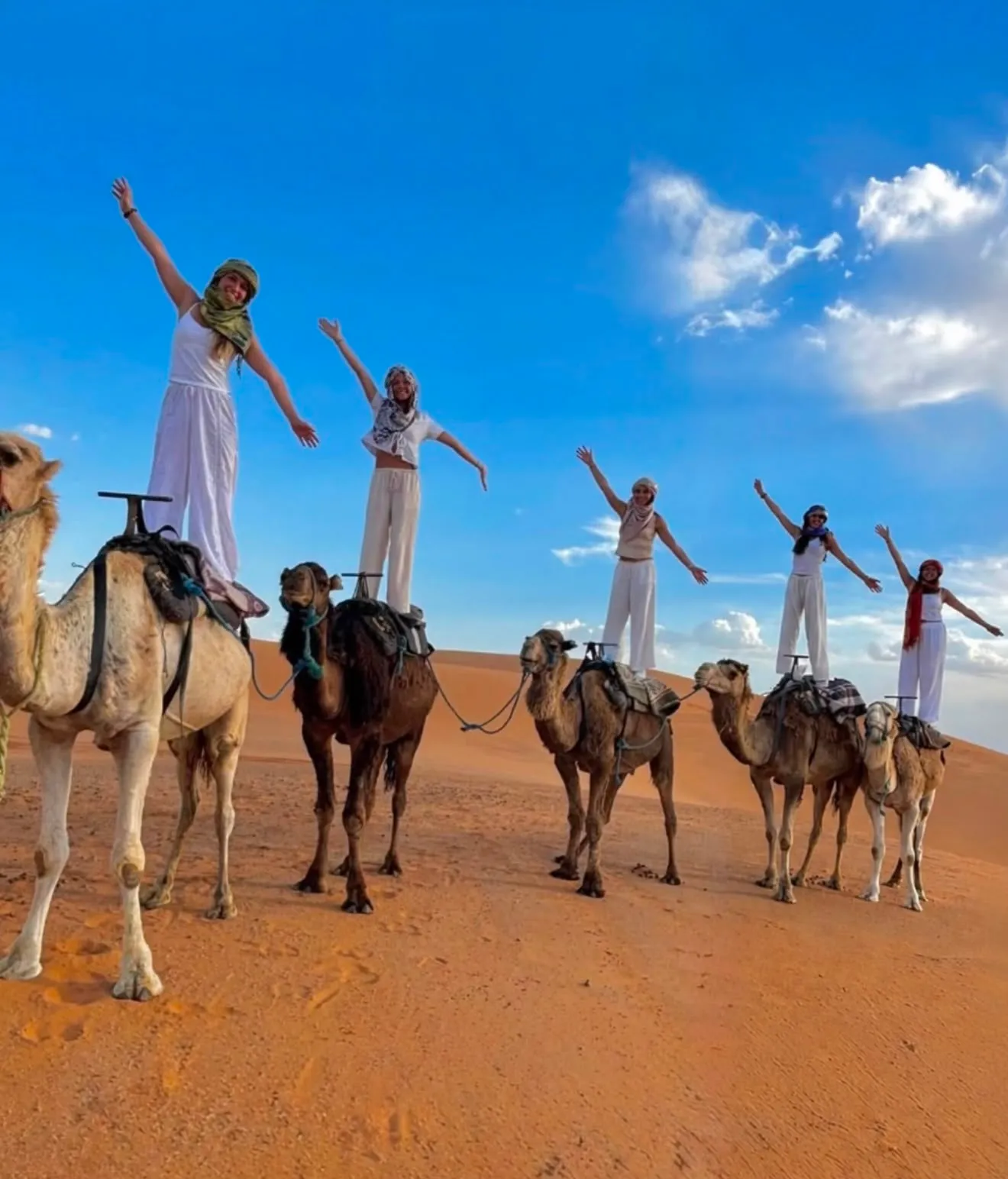
Ait Benhaddou is the natural first highlight on the road from Marrakech to the Sahara. After it, the route continues through Ouarzazate, the rose-growing Dades Valley and the dramatic cliffs of the Todra Gorge before reaching the Erg Chebbi dunes at Merzouga. That combination of architecture, mountains, oases and dunes is why this road is so loved.
If you have more time, the ksar also slots neatly into longer itineraries that combine the imperial cities with the desert. Our overview of the imperial cities of Morocco and our 7-day Morocco itinerary show how to build a route around it without spending every day in the car.
Day trip or multi-day tour?
- Day trip from Marrakech: good if you only have one spare day and are not going to the Sahara.
- 2 days (Ouarzazate area): adds sunset light, a kasbah stay and possibly Telouet.
- 3 days to Merzouga: the classic choice, with Ait Benhaddou on day one and a night in the dunes on day two.
Plan your visit with our desert team
We are a small team based in Merzouga, and we drive this road constantly. We know which light suits the ksar, where to grab a good tagine lunch nearby, and how to pace the long drive so you arrive at the dunes in good shape. Our three-day trip from Marrakech through Ait Benhaddou to the Merzouga dunes starts from around €240 per person, and we are happy to adjust it for a slower pace or an extra night. Tell us your dates and travel style on our contact page and we will reply with a clear plan.